
Love Feast
Love Feast is celebrated on Maundy Thursday, the evening before Good Friday.
we also celebrates Love Feast the first Sunday of October, which is World Communion Sunday.
Love Feast
This traditional Brethren ordinance dates to the early days in Germany when the early Brethren were being formed and studying with Mennonites and Pietists. Traditionally, the Brethren Love feast consists of three parts, Footwashing, the Lord’s Supper, and bread and cup communion. Historically, it was performed whenever groups met to worship. In the United States, churches would hold a love feast annually, and churches all around would attend, resulting in several love feasts being attended yearly as all brothers and sisters fellowshipped together. After the church outgrew homes, constructed meetinghouses were simple buildings of one large room, with room for a cooking hearth, and benches that turned into trestle tables for the purpose of love feast. Today, each church celebrates Love Feast slightly differently. We have traditionally celebrated twice annually, once on Maundy Thursday, recalling the Last Supper Jesus shared with his disciples, and near the time of Advent, as we recall the One who “being in very nature God, did not consider equality with God something to be grasped, but made himself nothing, taking the very nature of a servant, being made in human likeness. And being found in appearance as a man, he humbled himself and became obedient to death- even death on a cross!” Philippians 2:5,6
Preparation:
The early church celebrated the Lord’s Supper often. However, Paul reminded the Corinthians “A man ought to examine himself before he eats of the bread and drinks of the cup. For anyone who eats and drinks without recognizing the body of the Lord eats and drinks judgement on himself.” I Corinthians 11:28,29. Historically, an elder of the church would visit with every member of the congregation in the month leading up to Love Feast to pray with them, and help them examine their hearts, so that there would be no division or animosity. Our sermon today helps us with this self-examination process. We ask that you spend time this week in prayer, asking God to give you a heart of gentleness and forgiveness. If there is someone with whom you have disagreement, now is the time to prayerfully seek reconciliation. If you need to speak to someone, please call me, or a brother or sister you can be open with. Having said this, Jesus washed the feet of the one about to betray him, and of disciples bickering over who would be at his right hand in the kingdom. I ask only that your heart be open to the work of the Holy Spirit within.
When we arrive on Thursday, we will meet in the Sanctuary to pray and thank God before joining in the fellowship hall.
Footwashing:
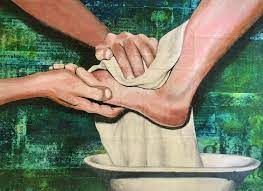
In John 13, we see Jesus girding himself with a towel and kneeling to wash the feet of his disciples. When he had finished, he said: “Do you understand what I have done for you? You call me Teacher and Lord, and rightly so, for that is what I am. Now that I, your Lord and Teacher, have washed your feet, you also should wash one another’s feet. I have set you an example that you should do as I have done for you.” John 13: 13-15.
The Mennonites took this admonition seriously, and the early Brethren adopted this practice as well after study of scripture. When we physically kneel to wash one another’s feet, we are following our Lord’s command, recalling His incredible humility, and pledging ourselves to serve and love our Brothers and Sisters. Each person washes another’s feet, then both stand and share a holy kiss, before the towel and basin move down the line. Thus each one is servant, and each one is served, and all are equal in submission and humility before our Savior. We have added a chair-based hand washing area for those physically unable to kneel. The sentiment is the same as we both honor and serve one another in Christ. During this time, we sing hymns from the hymnal, lifting our voices communally in praise to our God.
The Lord’s Supper:
After we wash one another’s feet, we share a meal in fellowship. The meal is simple yet filling, soup, crackers, cheese and fruit, with water, and there is enough for all. All are served before any eat. There is no hierarchy. We are all brothers and sisters in Christ. This is a joyous and holy time of sharing.
Bread and Cup communion:
At each setting will be a small cup of grape juice, and communion bread. After we have washed each other’s feet, shared a joyous meal together, we together recall the Blood of Jesus shed for the remission of sins, the Body of Jesus broken for us. We will break bread with one another, and drink the cup together. We recall the words of Jesus recorded in Luke: “This is my body given for you: do this in remembrance of me…This cup is the new covenant in my blood which is poured out for you.” Luke 22:19,20.
After eating the bread and drinking the cup, we go out into the night as the disciples. We sing Blest be the tie that binds. We pray. Then we clean up together, reminded that we are all working together as one body of believers in Christ.
Please join us. If you have not participated before, and wish just to observe, we welcome you. If you wish to join your heart to ours in worship and service, we welcome you.
References
Brown, D. W. (2005). Another way of Believing: A Brethren Theology. Brethren Press.
Durnbaugh, D. F. (1997). Fruit of the Vine: A History of the Brethren 1708-1995. Elgin: Brethren Press.
Stoffer, D. R. (1989). Background and development of Brethren Doctrines 1650-1987 (Vol. 2). (W. R. Eberly, Ed.) Philadelphia, Pennsylvania: Brethren Encyclopedia, INC.
Student Bible New Internationsl Version. (2002). Zondervan.